





















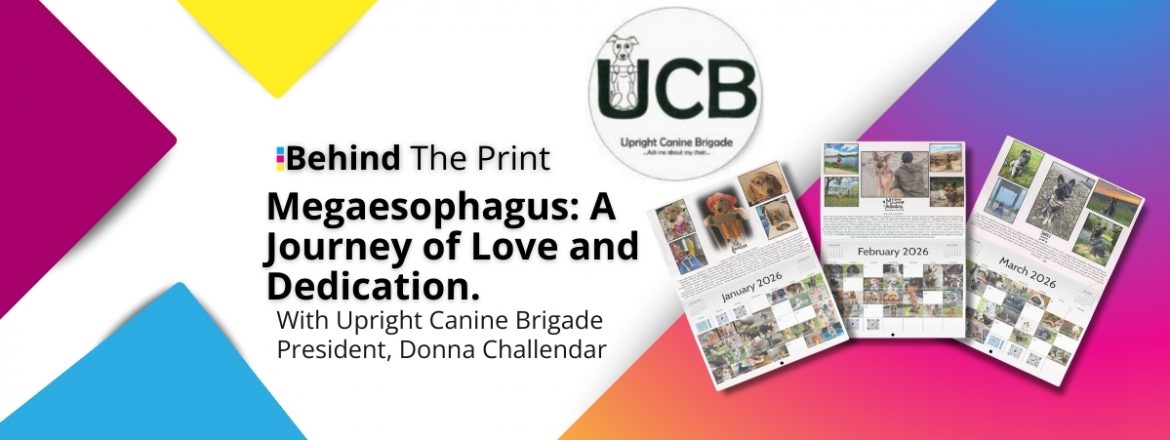
Megaesophagus: A Journey of Love and Dedication
In this episode of Behind the Print, we’re joined by Donna Challendar, President of the Upright Canine Brigade and Margaret Douville administrator of the Upright Canine Brigade. Donna walks us through how she uses print to raise awareness and education about megaesophagus – a rare condition that makes it difficult for dogs to swallow food.
Below, you’ll find the transcript of our conversation, edited for clarity to ensure easy reading. If you want the full, authentic experience, make sure to check out the video attached below.
Connor: Welcome back to the Behind the Print Podcast, where we feature industry leaders and uncover the creative minds and their businesses within the world of professional printing. Our mission is to provide you with inspiring actionable resources that elevate your business projects and accelerate your journey to excellence in profit and in print.
Today I’m joined by the president and founder of the Upright Canine Brigade, Donna ChallendarAnd Margaret Douville, administrator of the Upright Canine Brigade, welcome to the podcast.
Donna: Thank you.
Margaret: Hello.
Connor: If you guys are ready, let’s just dive right in. Sound good?
Donna: Sounds good.
Margaret: Sounds great.
Connor: So tell me a bit about yourselves and what you guys do.
Donna: Yes, we are an awareness and support group for a canine megaesophagus. And what that is, dogs that have an enlarged esophagus, their muscles in the esophagus do not work to propel the food and water down into the stomach.
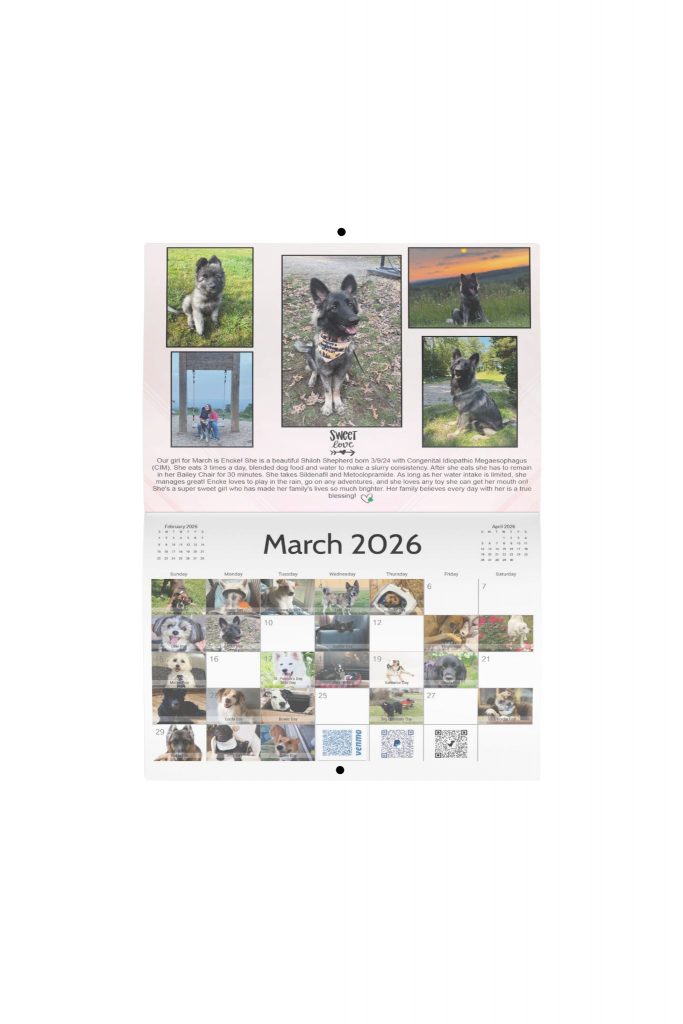
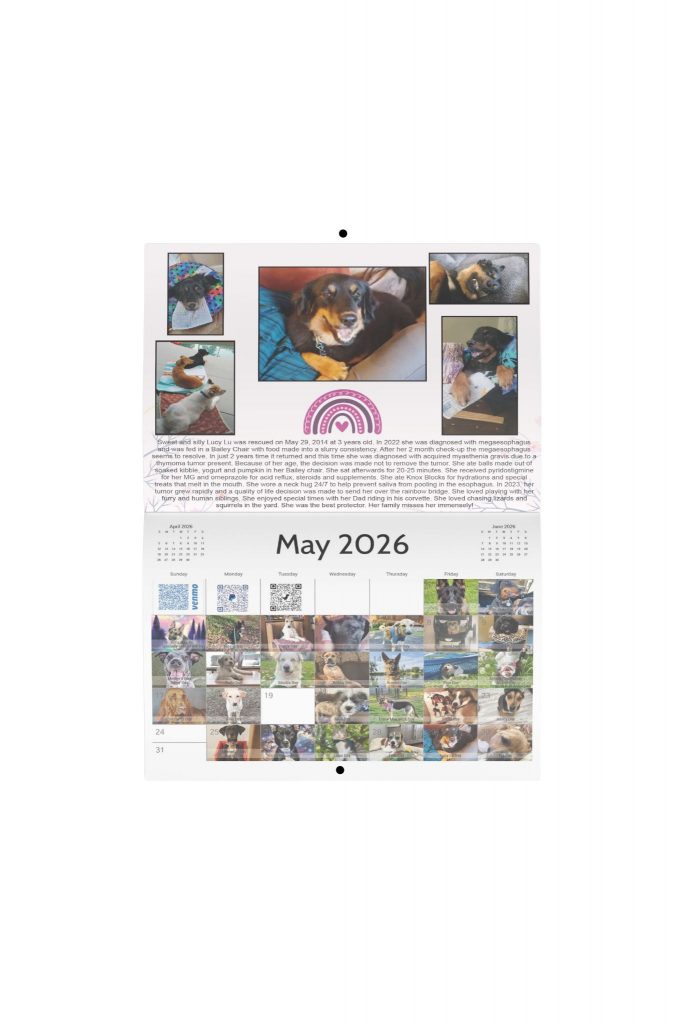
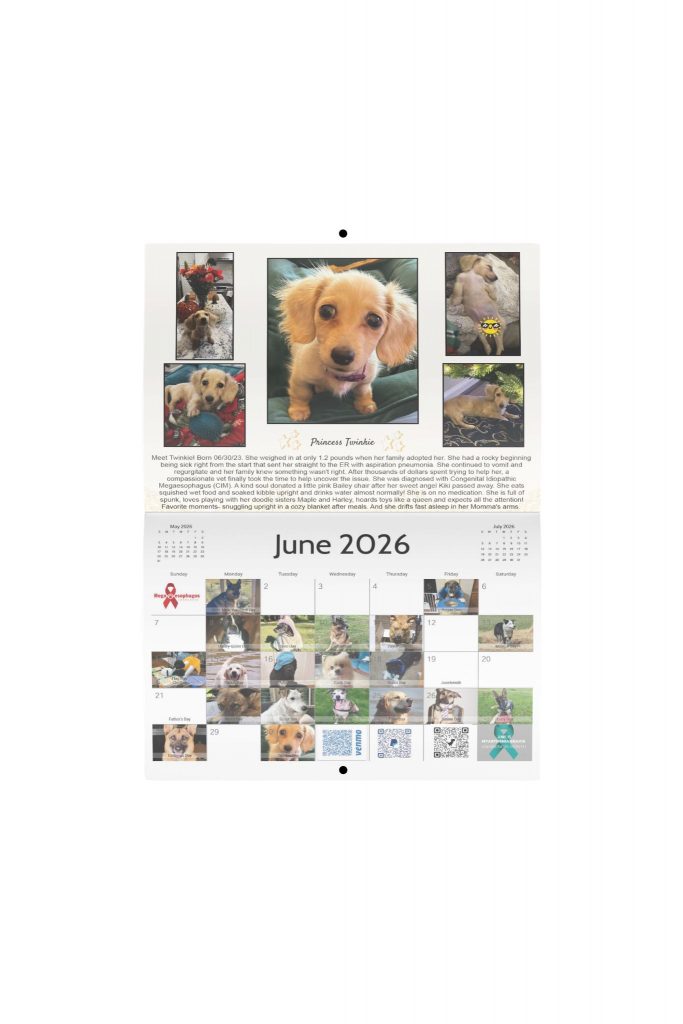
So they have to eat in an upright position called a Bailey chair, a special feeding chair, and that allows gravity to do the work that the esophagus muscles can’t do. We hold a calendar contest in the month of June. June is canine mega esophagus awareness month, and everyone is eligible to participate.
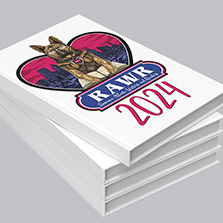
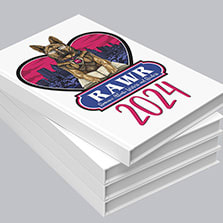
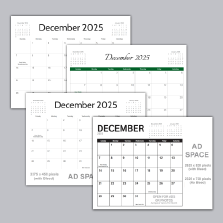
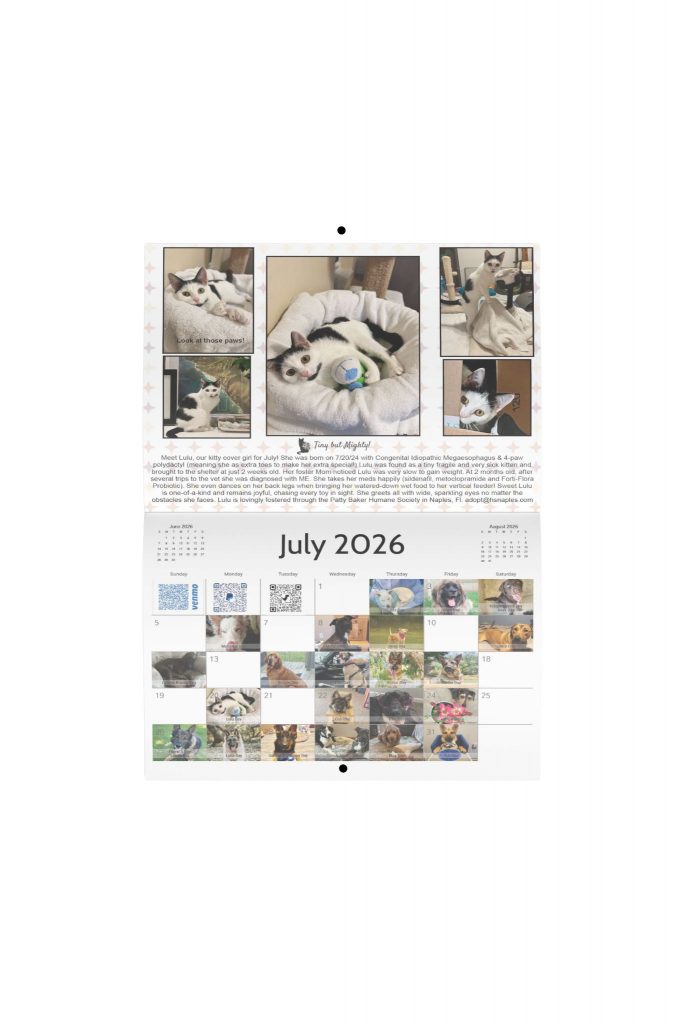
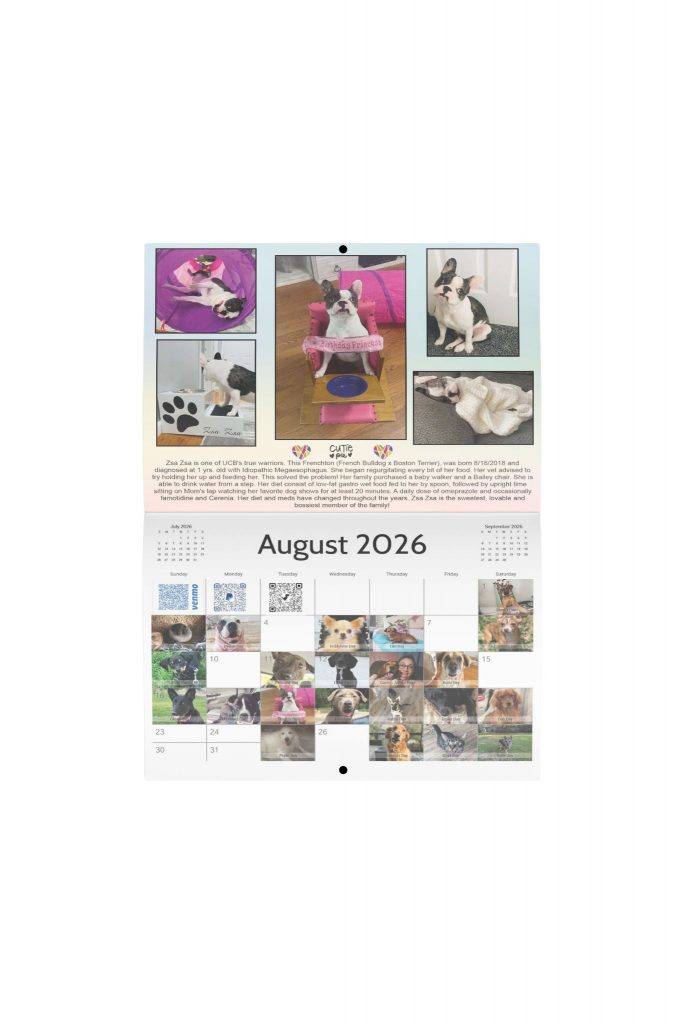
There’s no fee to participate in the contest, and then the 12th. Dogs or cats? We have cats as well in the group receive, the most votes will receive their month on the calendar, and then every dog that is entered, or cat that is entered receives their very special day on the calendar. Then we sell these calendars, wait, we have them printed through PrintingCenterUSA, and every dime goes to megaesophagus research, and we have contributed over.
$60,000 to mega sous research through the calendar contest. So that’s basically one of the things that we do that we’re very proud of.
“We are an awareness and support group for a canine megaesophagus. And what that is, dogs that have an enlarged esophagus, their muscles in the esophagus do not work to propel the food and water down into the stomach.”
Connor: That is very impressive. What about you, Margaret? Can you tell me a bit about yourself?
Margaret: I became aware of these groups for supporting family members and owners of pets with megaesophagus back in 2012.
I had a dog named Sparky, a Beagle, who was diagnosed with megaesophagus in the year 2000. And between my husband, our veterinarian, and myself, we managed his condition for nearly 14 years. And it was in 2012 that I met Donna through the megaesophagus support groups on Facebook. And it turned out at that point, I really didn’t need the support, but I was able to offer support to others.
When they’re newly diagnosed and, and very worried that they, you know, what do we do next? It’s a incredible community of caring, giving, and sharing experiences. We’re not veterinarians, but we, we provide that emotional and practical support. So that’s how I came to become part of this entire community.
Connor: What can you tell me about your typical clients?
Donna: Our members come from all over the world for support. In our Facebook group, we have over 20,000 members, and when they come in, they’re usually quite frightened. They’re afraid that they may have to put their dog down, they’re not sure how to manage the disease.
And what we do is we collectively through the, the other members can respond as well and help them out with different ideas because there’s not one way to manage the disease. Each dog is managed in different ways. One of the best things I think that we ever did was start this Facebook group Upright Canine Brigade, because there’s just so much help out there and people gravitate towards it. It’s a beautiful group.
Connor: Sounds like a beautiful group. Can you expand on that a little more, like how you go about helping these individuals overcome this?
“Each dog is managed in different ways. One of the best things I think that we ever did was start this Facebook group Upright Canine Brigade, because there’s just so much help out there and people gravitate towards it. It’s a beautiful group.”
Donna: Well, it’s not just me, it’s our faithful members like Margaret, who dealt with this for 14 years with her dog.
She would, come in and, and explain to, to a new member that might be very, very worried about their, their animal, that this can be managed and it gives them hope. Inspiration. We also do work very hard with our research partners as well, and they are hard at work at finding genetic connections.
They’re hard at work, at finding better management skills for, for the, for their clients. And, and it, and that is where some of the research money goes to from, from the calendar contest.
Connor: That’s a very interesting cause it sounds like you’re just letting ’em know that it’s not necessarily a death sentence, that it’s Correct.
It’s manageable.
Donna: Absolutely.
Connor: So you guys already have a very unique organization, but can you tell me about how you stand out from other nonprofits in your field?
Donna: Well. I’m not sure if there is any other nonprofits in our field to tell you the truth. We jumped on it. In 2015, we decided that we would become a nonprofit, because we started going to vet conferences and pet events and sharing some of the dogs and things, management skills with other people and, and actually.
Sharing what megaesophagus is because many people do not have never heard of it. So we decided that in order to pay for a lot of things that we were doing, we needed to become a nonprofit. And, and that’s, that’s how it, how it began. I’m not sure there, there’s a lot of rescues out there that we help that are nonprofits, but I think we really have a niche there. Can you think of one Margaret? I can’t think of one.
Margaret: No, I can’t either. I think we’re the only one.
Donna: Mm-hmm.
Connor: So May am I, am I saying this right? megaesophagus? Is that how you pronounce it? Correct.
Donna: Yes, it means great big esophagus.
.
Connor: Is this like a, a, a rare condition?
Donna: Well, it’s not as rare as it as it sounds because some dogs are born with it and other dogs arrive with it at, at different types of diseases. Myasthenia gravis is one of them. It’s a neuromuscular disease. That’s what our dog had and that’s how I got started in it.
Yeah, Cody he was barely able to walk. And the majority of dogs with myasthenia gravis also have megaesophagus. About 89 to 90% of them have megaesophagus with their disease. So it’s a major symptom. So we do see a lot of our members with myasthenia gravis and hypothyroidism can cause it as well.
And that’s pretty common in dogs Addison Disease. They get dogs get that too. Or they could be born with a stricter running across their esophagus and kind of choking it out. And that’s called persistent, right? Aortic arch. Some puppies are born that way. It’s a, it’s a, it’s a heart vessel that should have dissolved before the puppy was born.
It has no function. But it remains and it chokes off the esophagus so they can go in and do surgery for that, which is wonderful. Which, you know, anytime that they can do a surgery to correct, correct. Something like that is wonderful.
Margaret: And then Donna, you had mentioned that those three diseases, myasthenia gravis, Addison’s disease and hypothyroidism, those can all be treated correct.
And once they’re treated, it can minimize the effects of the megaesophagus. Sometimes it resolves completely. Other times it makes it a little bit more manageable. So tho those are the ones that can be medically treated.
Connor: Is megaesophagus, is that more common in certain breeds?
Donna: We do see a lot of German Shepherds in the group, and there is a genetic test available for German Shepherds for the breeders. We’re hoping that more breeders will take advantage of that. We it see every breed as well as cats. And horses. Mm-hmm. We’ve had horses in our group as well. You know so any mammal can get megaesophagus
Margaret: Even people can get it.
Connor: Wow. That’s, I didn’t know that.
Donna: Yep.
“We do see a lot of German Shepherds in the group, and there is a genetic test available for German Shepherds for the breeders. We’re hoping that more breeders will take advantage of that. We it see every breed as well as cats. And horses. Mm-hmm. We’ve had horses in our group as well. You know so any mammal can get megaesophagus”
Connor: had never heard of the condition before you signed up to do the podcast.
Donna: Yep. And that’s why we do a lot of pet events and dog shows. We were just at the National Dog Show, the one you see on Thanksgiving.
We were just there exhibiting there. And there’s a lot of people that have never heard of it and they don’t understand the symptoms of it. The major symptom is regurgitation of food. So. What happens is the dog will eat and then it never reaches the stomach because the muscles are not working, so it will just be expelled.
That’s called regurgitation, and it’s different than vomiting because sometimes a pet parent will go into the vet’s office and say, I don’t know what’s wrong with my dog. He or she keeps vomiting and it’s really not vomiting, it’s regurgitation. And if they say it’s regurgitation, then the vet will know where to look because it’s just a simple x-ray that can bear it out.
So yeah, we definitely feel that witnessing to people around the country is, is helping. It’s helping save dogs because a lot of times they don’t know. They don’t know, and they’re sent home thinking it’s a food allergy, try a different food, or sometimes they go through exploratory surgery thinking the dog ate a sock or something, and here it is just that big old megaesophagus. And they can also find it if the dog has aspiration pneumonia, they’ll go do an x-ray and then they’ll see that big esophagus and figure it out. But we want them not to be sick before they find, find, find out they have it. So that’s why we like to tell people about the differences between vomiting and regurgitation.
Connor: Can you tell me about any major milestones or accomplishments that have defined the Upright Canine Brigade?
Donna: I believe that we have made great strides in research and supporting research. We’ve been written up in several journals as contributing factors. Some of our members volunteer to send samples of tissues and blood in order to bear out a genetic issue, and I believe that is really, really important.
That we find the answers and unlock the mysteries of megaesophagus. So I believe that’s one of, one of the major things that we do, and the calendars is what makes this happen.
Connor: And also the whole, uh, what was it, $60,000 you managed to raise?
Donna: Yeah, yeah. Selling those calendars.
Connor: That’s quite the accomplishment.
Donna: Yeah. Thank you.
Connor: Can you tell me about any challenges or obstacles that are holding back your organization?
Donna: Well. I wish that the veterinarian community, would step up with more education in megaesophagus. And they, they generally don’t, they touch on it, but they don’t go over it a lot. And I think this is a stumbling block for our members because they have to find someone, a veterinarian or a specialist to manage it with them.
Sometimes it’s difficult to find one that has a lot of experience or some experience with it and to guide them down the right path. I would hope that in the future, that we would see more in their curriculum when they’re studying internal medicine and neurological diseases as well.
Connor: Can you tell me about how print has helped elevate your business? I have one of your calendars right here. Your most recent one, and it turned out great.
Donna: Thank you, and I do get a lot of help. I have a a web designer, but she’s couldn’t make it onto the podcast. I do get a lot of help with that, and she designs a lot of the covers and the inside pages about our community.
Yeah, it’s just amazing how easy it is for me and I’m, you can see I’m not technically advanced and how easy it is for me to put together this calendar. It’s time consuming for me because I put every single dog in there. So if you look through, you’ll see. You know, on all the, all the pages, you’ll see that there’s, there’s quite a few that, that make it in there on their, on their special day.
And so it’s a little time consuming for me, but it’s easy. It’s not, it’s not the format is not difficult. So I enjoy it. I really enjoy it. And then I talk with the, winners and get the inside scoop on their dog or, or cat it’s more like a one oh one-on-one. I really enjoy getting to know the members and, and the animals.
Connor: So I have a bit of a different question for you guys. If either of you had a day completely free to spend however you’d like, how would you spend it?
Donna: I love spending time with my dog, you know, and my husband, he’s okay too.
Margaret: For me, spending time at home with my husband and I have one beagle at the moment, and that’s what it was like during the pandemic. You know, the, the home is just where I want to be. Luckily, I get to telecommute so I can be at home with my, with my dogs and my, and my husband.
So, yeah, that’s a perfect day for me too. I’m right with Donna.
Connor: Sounds like a good day. So one last question for you. How can our listeners get in touch with you? Learn more about the megaesophagus condition, make a donation, submit some photos for a calendar. What’s the best way to get in touch?
Donna: Well, the best way to view what we do is on our website, which is it’s long, but once you get it in there, it’s caninemegaesophagusinfo.com. And if there’s anyone that needs help, our Facebook group is just wonderful. And again, it’s Upright Canine Brigade on Facebook awareness and support.
Connor: Okay. Well, uh, did you guys have any questions for me?
Donna: No I’m just so appreciative of the care and, that, that your company gives me when I have a question and sometimes I do have questions and everyone is very responsive and very polite and very businesslike and I really appreciate that.
Connor: Well, like I said, we appreciate you printing with us.
Well, I’d say that’s a wrap on another episode of Behind the Print. Thank you to our listeners for joining us as we explore the artistry and innovation of the printing world. Remember, having a strong vision, building the right strategy, and using tools like Print to amplify your message will make your brand stand out from the crowd.
If you enjoyed today’s episode, be sure to get your sample pack today from printing center usa.com and share it with your fellow business enthusiasts. Until next time, keep those creative sparks flying and remember, there’s always more to discover behind the print.