























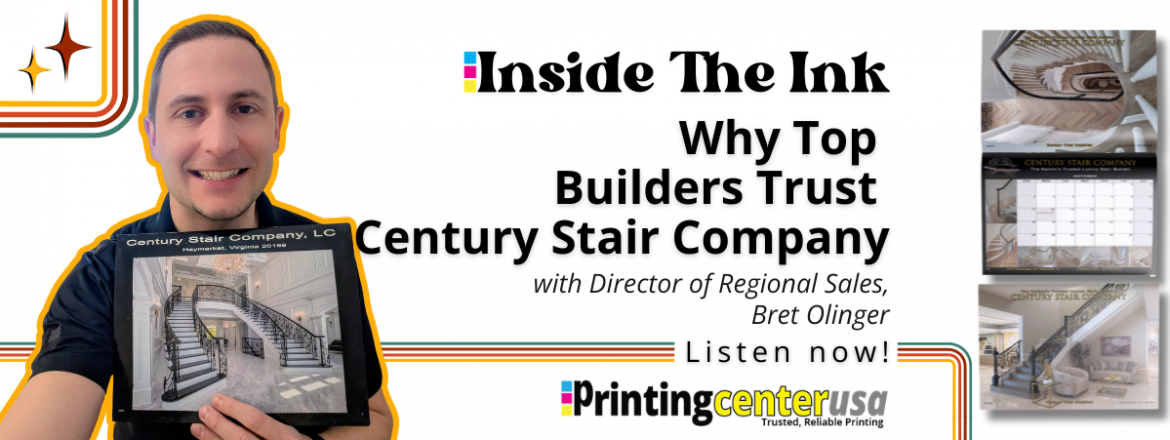
Inside the Ink with Century Stair Company
Welcome to Inside the Ink, where creativity and print come together. In this episode of Inside the Ink, we sit down with Brett Olinger of Century Stair Company to explore how a product most people overlook can become the defining statement of a home. What many see as a simple structural necessity, Bret and his team see as art, architecture, and experience. With over a decade in the stair industry and now serving in a sales leadership role, Bret shares how his mindset evolved from selling a product to educating clients and elevating design.
From collaborating with architects in the earliest design phases to reimagining marketing strategies through print and digital outreach, Century Stair Company is redefining what it means to build with intention. This conversation is especially valuable for marketing professionals, small business owners, graphic designers, and print enthusiasts who want to see how thoughtful positioning, relationship building, and tangible marketing tools can transform even the most functional product into a premium experience.
Below, you’ll find the transcript of our conversation, edited for clarity to ensure easy reading. If you want the full, authentic experience, make sure to check out the video attached below.
“It’s not about selling stairs. It’s about designing art.” Bret Olinger
10-minute read
Transcripts from Inside the Ink with Director of Regional Sales from Century Stair Company, Brett Olinger
Zoe Fisher: Welcome to Inside the Ink, where we uncover real stories from the creative minds and businesses shaping professional printing. Today I’m joined by Bret from Century Stair Company. We were just talking about the snow storms hitting both Montana and Virginia, which feels very fitting for a conversation about construction and building.
You sell stairs for a living, but you clearly don’t see them as just stairs. When did that mindset shift for you?
Brett Olinger: About a year and a half into my career. I’ve been with Century Stair for 11 years now, and early on something just clicked. I was brought up by people with decades of experience. Our CEO has been in the industry for over 30 years, and our sales team collectively has hundreds of years of experience. That mentorship shaped me.
When you walk into most homes, the first thing that greets you is the staircase. It’s often the focal point whether people consciously realize it or not. Once I started seeing stairs that way, as the visual anchor of a home, I stopped thinking of them as just a way to get upstairs.
Zoe Fisher: Was there a moment when you realized your role was less about selling and more about educating?
Brett Olinger: Definitely. Early in my career as an account manager, I was focused on day to day sales. But in the last couple of years, as I moved into a director of sales role, my perspective changed. Now I think bigger picture. I’m thinking about design, about collaboration, about long term relationships.
That shift toward education has been incredibly rewarding. It’s not just about moving product. It’s about helping people understand how a staircase can transform their space.
Zoe Fisher: Most people don’t think twice about staircases. Why do you think that is?
Brett Olinger: Because they see them as purely functional. Kitchens get all the attention. Closets get attention. But stairs are often viewed as a way to get up and down.
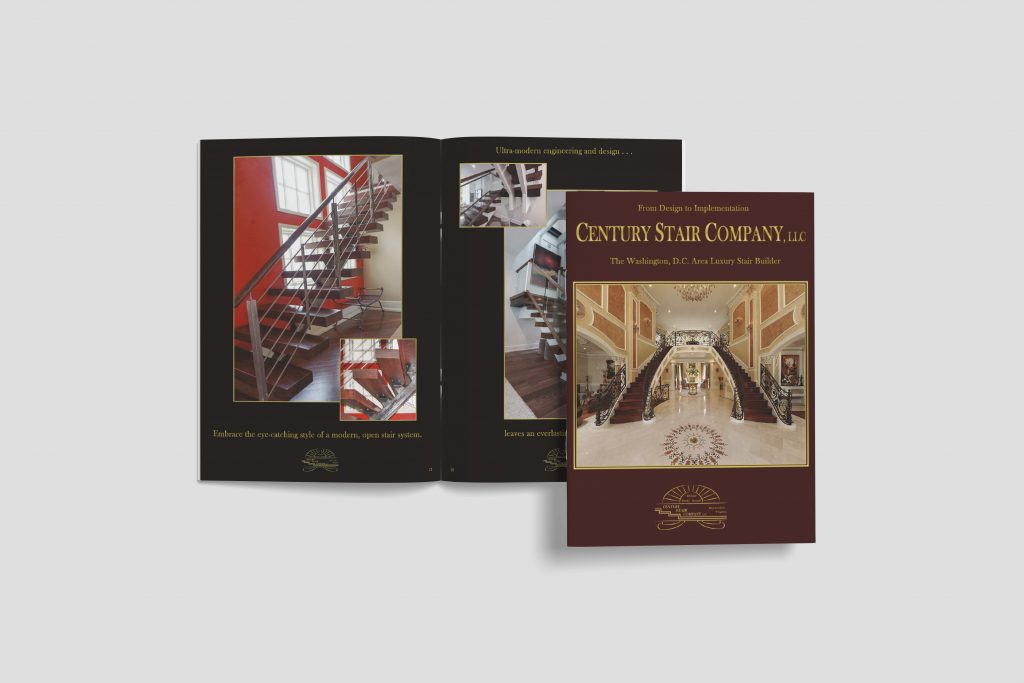
That’s changing, though. Homes are more expensive than ever. When someone is investing a million dollars or more into a home, they want to see where that money went. They want a statement piece. Years ago, everyone wanted traditional curved stairs. Now we see demand for modern, glass, minimalist designs. Trends shift, and stairs are finally getting the spotlight.
I always tell people, we don’t just make staircases. We make art. We create focal points and statements.
Zoe Fisher: From a business perspective, what separates companies that treat design as an afterthought from those that win long term?
Brett Olinger: It’s about what happens on the front end. In our industry, there’s often a disconnect between architects, builders, and homeowners. We try to bridge that gap. We get involved early in the design phase and ask, “Is there a better way to do this? Can we elevate this design?”
It’s not just about the stairs either. The rail system is equally important. If you design an incredible staircase but ignore the rails, the project can fall apart visually. Everything has to work together. We look at the entire turnkey package and make sure it’s cohesive.
Other companies might just follow the plans and move on. We ask whether we can make it better.
“If you’re passionate about it, other people will be too.” Bret Olinger
Zoe Fisher: Some builders focus on speed and function. Why does investing in design still matter when timelines and budgets are tight?
Brett Olinger: Because you can’t put an afterthought in the middle of a grand home. You can’t drop in a basic stair in a luxury space and expect it to feel cohesive. That staircase is going to be in the center of your home. It needs to reflect the quality of everything around it.
If you miss that opportunity, it shows.
Zoe Fisher: How do you build trust instead of just filling space?
Brett Olinger: We focus on relationships. We call ourselves a soup to nuts company. We’re there in the design phase at the beginning, and we’re there at the very end installing handrails, which are often one of the last elements before a homeowner moves in.
Because we’re present throughout the entire build, we naturally build relationships. It’s not about moving to the next sale. It’s about being part of the process from start to finish.
Zoe Fisher: Have you built stairs for anyone famous?
Brett Olinger: Our CEO has worked with some high profile clients over the years. Being in the Washington DC area, we’ve built stairs for professional athletes and public figures. One of our account managers even got an autograph from a Washington Capitals player during a project. Those moments are fun, but ultimately we treat every client with the same level of care.
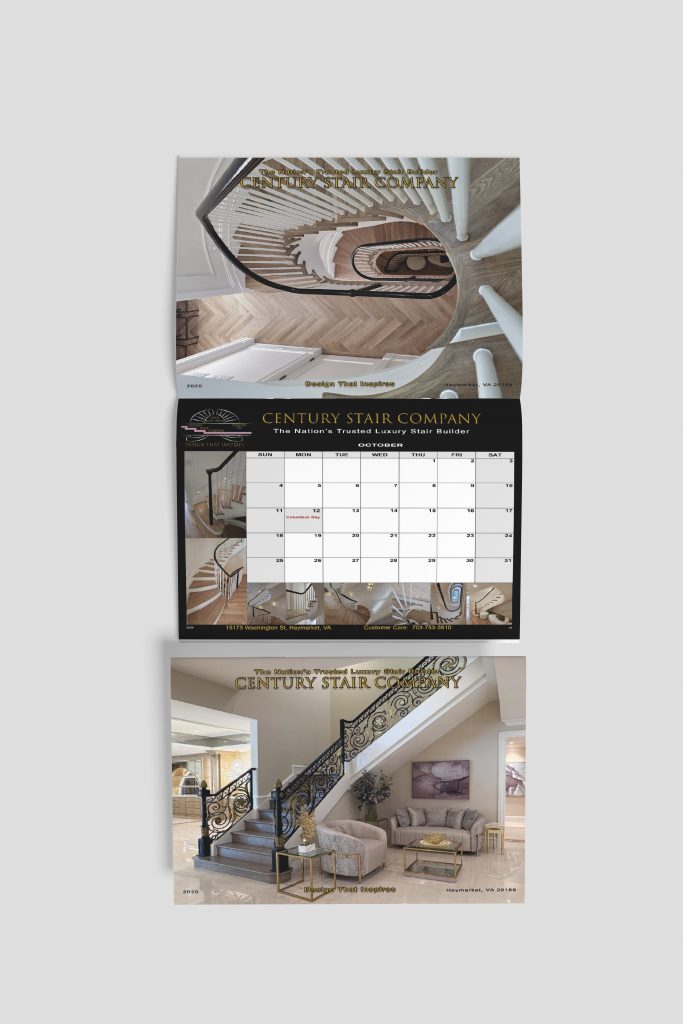
Zoe Fisher: Let’s talk marketing. How are you using print today?
Brett Olinger: We’re reinventing ourselves. In the past, we relied heavily on word of mouth. Our previous leadership built a strong reputation that way. But today, marketing is essential.
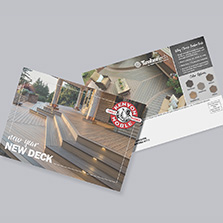
We’re investing in social media and print. We’re targeting architects more intentionally, especially during the design phase. Print materials help us stay top of mind. When you can place something tangible in an architect’s hands, it keeps your brand present in a way digital sometimes doesn’t.
Zoe Fisher: What would you say to someone who feels stuck selling a “boring” product?
Brett Olinger: Rethink what boring means. There are people who care deeply about what you do. If you’re passionate about your product, that passion shows. And when you care, others will care too.
Stairs might sound boring to some people. But to us, they’re a statement. If you believe in your product, that energy is contagious.
“We don’t make staircases, we make art, we make focal points, we make statements.” Bret Olinger
Zoe Fisher: Are you more detail oriented or big picture?
Brett Olinger: Both. I love the technical details. We work on projects that can cost hundreds of thousands of dollars. One small miscalculation can cause a failure. Solving those problems is exciting.
At the same time, I’m thinking about growth, strategy, and where we’re headed as a company. I joke that I’m a professional firefighter. In management, everyone’s problems become your problems. You’re constantly solving issues and moving forward together.
Zoe Fisher: What do you do outside of work?
Brett Olinger: I have two young kids, so they take most of my time. But I’ve always loved motorcycles. Two wheels are my passion. I also enjoy running and playing disc golf. It’s affordable, it gets you outside, and it’s a lot of fun.
Zoe Fisher: How can listeners see your work?
Brett Olinger: We’re on Houzz with around 150 projects showcased. That’s a great place for inspiration. We’re also active on Facebook and Instagram under Century Stair Company. People can browse our work, get ideas, and reach out from there.
Zoe Fisher: Amazing well check them out and thank you for joining me on the podcast today Bret!
Brett Olinger: My pleasure!
Where Craftsmanship Becomes a Statement
Century Stair Company reminds us that even the most functional elements of a home can become art when approached with intention. By stepping into the design phase early, collaborating closely with architects and builders, and treating every staircase as a statement piece, Brett and his team have elevated what many consider a background feature into a focal point.
For marketing professionals and small business owners, the lesson is powerful. No product is inherently boring. Positioning, passion, and education make the difference. Graphic designers and print enthusiasts can also appreciate how tangible marketing materials and strong visual storytelling help bring high end craftsmanship to life.
Whether you’re building homes or building brands, the message is clear: design matters. Relationships matter. And print continues to play a vital role in keeping your work visible, memorable, and impactful. When craftsmanship and creativity meet, even a staircase can transform an entire experience.